When establishing a commercial oil extraction facility, the very first parameter you must lock down is your hourly processing capacity (KG/HR). If you underestimate your capacity, your plant becomes a production bottleneck. If you overestimate, you bleed capital on idle machinery.
For entrepreneurs planning a full-scale factory setup or managing the bulk procurement of processing lines, choosing between 50 KG/HR, 100 KG/HR, and 150 KG/HR systems defines the entire financial trajectory of the plant. At TechVMouta, we manufacture high-capacity industrial machines in Bulandshahr, UP. In this guide, we break down exactly what each capacity tier actually delivers on the factory floor.
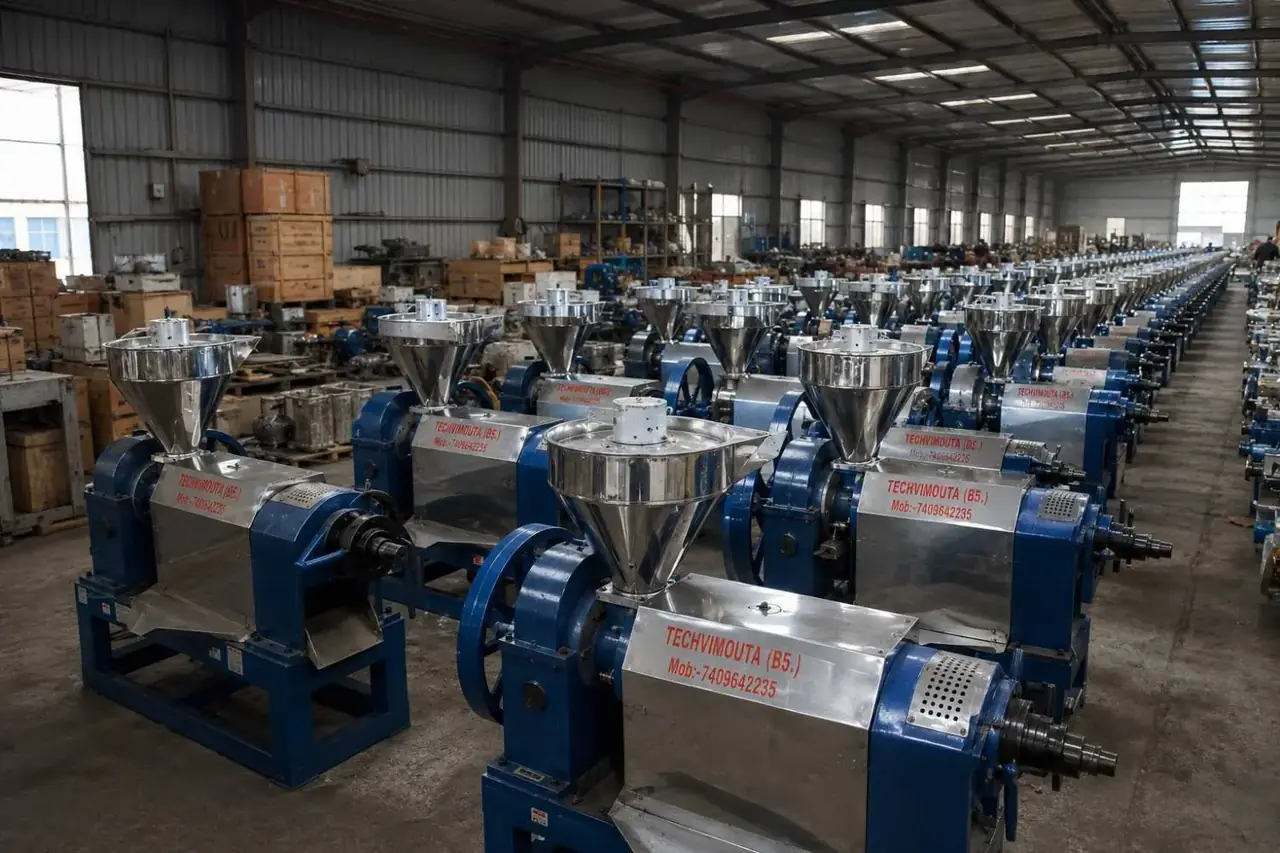
The Capacity Breakdown
1. The 50 KG/HR Expeller: The Domestic Toy (Avoid for B2B)
Many local traders advertise cheap 50 KG/HR machines. These are typically lightweight, 3 HP to 5 HP tabletop units. If you are running a serious commercial business, the 50 KG/HR category is a financial trap.
- The Reality: Crushing hard seeds like Sarso (Mustard) or Groundnut requires immense torque. A 50 KG/HR machine struggles, overheats within 2-3 hours, and must be shut down to cool.
- Burnt Oil: Because of the small chamber diameter, friction is intense, often heating the oil to 80°C and destroying the nutrients.
- Conclusion: It is fine for domestic kitchen use, but settling for 50 KG/HR units creates an immediate operational bottleneck for any commercial enterprise.
2. The 100 KG/HR Expeller: The Startup Sweet Spot
This is where true commercial extraction begins. A 100 KG/HR machine (typically driven by a 7.5 HP to 10 HP motor) is the absolute minimum requirement for a serious "Kachi Ghani" retail outlet or a small-scale factory.
- The Reality: It comfortably crushes 1,000 KG (1 Ton) of seed in a standard 10-hour shift.
- Durability: Built on a heavier cast-iron chassis, it can absorb multi-shift operational stress without vibrating.
- Conclusion: If you are launching a new oil brand or supplying local markets, the 100 KG/HR setup delivers the fastest Return on Investment (ROI).
3. The 150 KG/HR Expeller: The Dedicated Workhorse
If you already have established wholesale buyers or are planning the bulk procurement of machinery for a multi-line factory floor, the 150 KG/HR to 200 KG/HR machine (driven by a 15 HP motor) is your ultimate weapon.
- The Reality: Capable of crushing 1.5 to 2 Tons per shift. When deployed in parallel (e.g., three 150 KG/HR units side-by-side), they offer massive, redundant commercial output.
- Conclusion: Ideal for continuous 24/7 industrial extraction, ensuring your supply chain never dries up during peak festive seasons.
The TechVMouta Hero Advantage: Japanese Helical Gears
Whether you choose a 100 KG/HR or a massive 250 KG/HR system, capacity means nothing if the machine breaks down. Ordinary local machines use Spur Gears that snap under heavy industrial torque.
TechVMouta Commercial Expellers are equipped exclusively with Case-Hardened Japanese Helical Gearboxes. This ensures buttery-smooth torque transmission, 100% vibration-free operation, and keeps the oil extraction temperature at a pure 3°C to 4°C above room temperature.
Comparison Matrix: 50 vs 100 vs 150 KG/HR
| Specification | 50 KG/HR (Local) | 100 KG/HR (TechVMouta) | 150 KG/HR (TechVMouta) |
|---|---|---|---|
| Motor Required | 3 HP - 5 HP | 7.5 HP - 10 HP | 15 HP |
| Operation Time | Max 2-3 Hours | 10-12 Hours Continuous | 24/7 Multi-Shift |
| Gearbox Standard | Spur Gear (Noisy) | Japanese Helical (Silent) | Japanese Helical (Silent) |
| Ideal For | Domestic / Home Use | Startups & Retail Units | Large Wholesale Plants |
Slashing Industrial Power Bills: The PM Series Motor Upgrade
When you scale up to 100 KG/HR or 150 KG/HR, your commercial electricity bill becomes your largest operating expense. Running massive induction motors wastes up to 25% of power through rotor heat loss.
At TechVMouta, we strongly advise pairing your commercial expellers with our PM Series Industrial Motors. Because PM Series motors have zero power bleed, your 100+ KG/HR heavy-duty factory lines will consume up to 30% less active electricity, recovering your machinery investment in record time.
Get a Custom Factory Setup Quote
Don't gamble on undersized machinery. Connect directly with TechVMouta's manufacturing plant in Bulandshahr. We provide customized capacity mapping, direct factory pricing, and PMEGP subsidy documentation.
Chat with Our EngineersFrequently Asked Questions
Q: Which capacity — 50, 100, or 150 KG/HR — is most profitable?
It depends on your daily production target and raw material supply. Most commercial oil mill startups find the 100 KG/HR range balances output with manageable investment.
Q: What's the difference between input capacity and output capacity?
Input capacity (KG/HR) refers to how much raw seed the machine processes per hour; actual oil output depends on the seed's oil content and extraction efficiency.
Q: How does the PM Series Motor upgrade affect these capacities?
TechVMouta's PM Series Motor upgrade reduces industrial power bills significantly at every capacity tier, since it eliminates rotor electrical losses found in standard motors.
Q: Should I choose based on today's demand or future growth?
Size for near-term demand with some buffer for growth, rather than buying maximum capacity upfront — an oversized machine idling below capacity increases costs without added revenue.